
A static QR code stores its content directly in the pattern, so it cannot be changed or tracked. A dynamic QR code stores a short link, which lets you change the destination later and see scan statistics. Static is simplest for content that will not change. Dynamic is better for print campaigns you may need to update or measure.
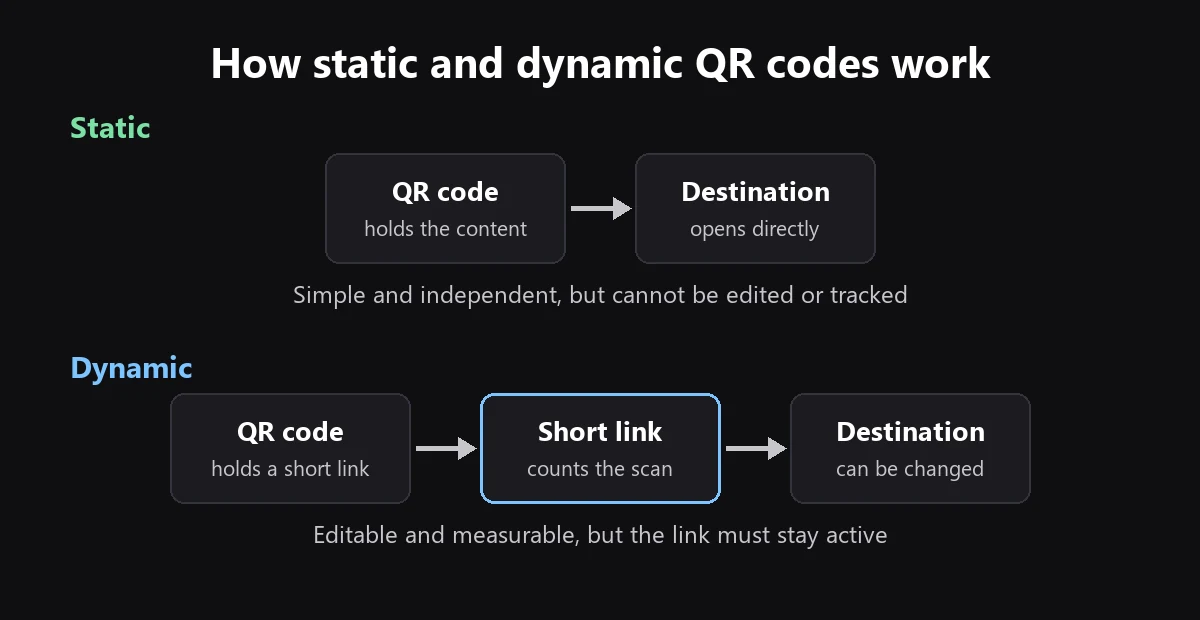
Static vs dynamic at a glance
| Static | Dynamic | |
|---|---|---|
| What the code holds | The content itself | A short link |
| Edit after printing | No | Yes |
| Scan statistics | No | Yes |
| Needs an account | Usually no | Yes |
| Depends on a service | No, apart from any linked website | Yes, while the link is active |
| Works offline | Yes, for text, contacts and Wi-Fi details | No, it needs internet to redirect |
| Code density | Grows with the content | Stays low, because it holds a short link |
When to use a static QR code
- The content will not change. A Wi-Fi network, a fixed web address or a piece of text are good examples.
- You want to share contact details. A vCard QR code saves your details straight to the phone.
- You do not want an ongoing dependency. The code works by itself, with no account to keep open. Learn more in Do QR codes expire?
- You do not need statistics. If you will not act on the numbers, there is no reason to collect them.
When to use a dynamic QR code
- The destination may change. Packaging, signs and printed brochures are expensive to replace, so being able to update the link matters.
- You want to measure results. Give each poster, flyer or location its own code and compare scans.
- Your link is long. A short link keeps the code simpler, which helps when you print it small.
- Your offer changes over time. A restaurant menu or a seasonal promotion can point somewhere new without new prints.
Which one should you choose?
Ask two questions before you print:
- Will I ever need to change where it goes? If yes, or if you are unsure and reprinting would be expensive, choose dynamic.
- Do I need to know how many people scanned? If yes, choose dynamic.
If both answers are no, choose static. It is simpler and has fewer things that can go wrong.
What you can measure with a dynamic code
On LinkInto, scan statistics show activity over time, along with country, device platform, browser and language. They show totals and general details, not who scanned the code. Treat them as a guide rather than an exact headcount, because automated visits can occur and repeat scans may not all be counted.
The free plan lets you create up to 5 QR codes and counts up to 50 scans a month. After that limit, the code keeps working but further scans are not counted until the next month. See the plans for current details.
Frequently asked questions
Can I turn a static QR code into a dynamic one?
No. A static code's content is fixed once created, so you need to create and print a new dynamic code.
Are dynamic QR codes more expensive?
They usually involve an account, and larger volumes often need a paid plan. Static codes are normally free. Compare the cost of a plan with the cost of reprinting.
Do dynamic QR codes work without internet?
The phone needs a connection to follow the short link. Static codes holding text, contact details or Wi-Fi settings can be read without one, while a static web address still needs internet to open.
Which is better for a business card?
Choose a static vCard if your details rarely change and you want contacts saved directly. Choose a dynamic code linking to an online profile if you expect your details to change or you want to count scans.